+90 505 054 8890 info@cottonandsteam.com
Soldes de Noël : réductions 29%! Achetez maintenant

The towel debate that housekeeping managers have already settled—and why their answer might surprise you.
Walk into any five-star hotel, and you’ll notice the towels immediately. Thick. Pristine. The kind of softness that makes you briefly consider slipping one into your suitcase.
For decades, “Egyptian cotton” was the phrase luxury hotels used to signal quality. It appeared on hang tags and in-room cards, a shorthand for premium that guests understood instinctively.
But something has shifted.
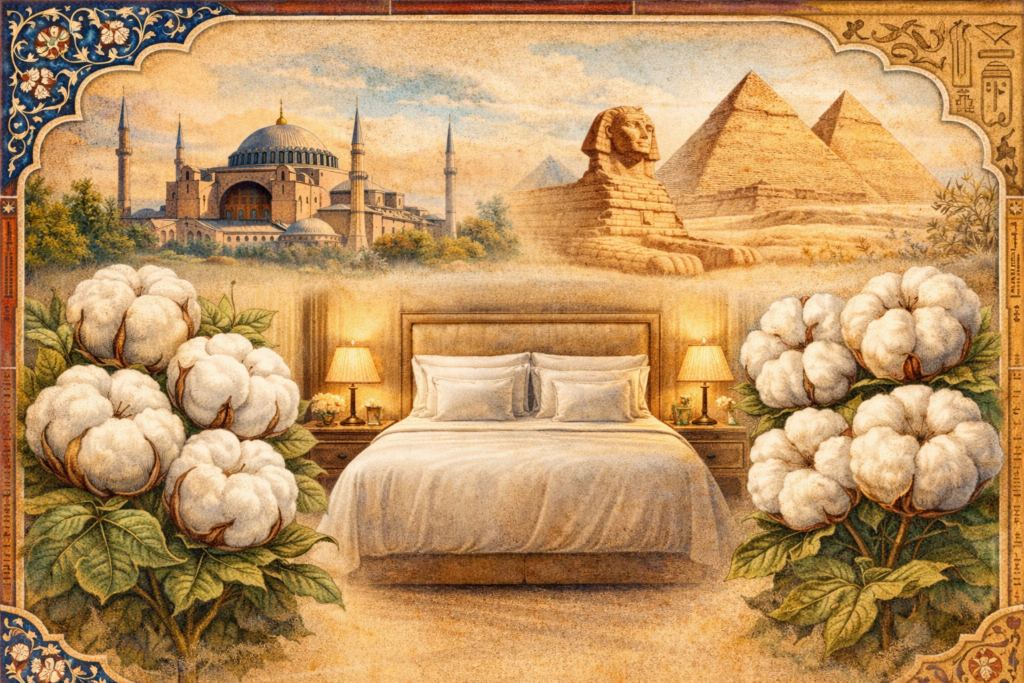
Quietly, without fanfare, the world’s most discerning hotels have been making a different choice. From boutique properties in Santorini to flagship resorts in the Maldives, Turkish cotton has become the insider preference—the choice of housekeeping directors who’ve tested everything and procurement managers who answer to the bottom line.
Why the change? And what does it mean for the towels in your own bathroom?
Let’s look at what the hospitality industry learned the hard way.
The Basics: Two Legendary Cottons
Both Turkish and Egyptian cotton earned their reputations legitimately. These aren’t marketing inventions—they’re distinct agricultural products shaped by geography, climate, and centuries of cultivation.
Egyptian cotton (Gossypium barbadense) grows in the Nile River Valley, where predictable flooding historically created ideal growing conditions. It’s known for extra-long staple fibers that produce smooth, lustrous fabric with a silky hand feel.
Turkish cotton (also Gossypium barbadense, but a different cultivar) thrives in the Aegean coastal region of western Turkey. The combination of Mediterranean climate, mineral-rich soil, and careful cultivation produces fibers that are both long and uniquely structured—creating cotton with exceptional absorbency and durability.
On paper, they sound similar. In practice, they perform very differently.
The Feel: Silky vs. Soft
Here’s where most comparisons begin, and where first impressions can be deceiving.
Pick up a high-quality Egyptian cotton towel, and your first sensation is smoothness. The tightly woven, high-thread-count construction creates a sleek, almost polished surface. It feels expensive. It photographs beautifully.
Pick up an authentic Turkish cotton towel, and the sensation is different—a plush softness that feels more organic, more textured. Less like a luxury product and more like something that wants to be used.
This isn’t a quality difference. It’s a philosophy difference.
Egyptian cotton is engineered to impress at first touch. Turkish cotton is engineered to perform over years of use. In fact, Turkish cotton towels are famous for becoming softer with each wash, as the fibers relax and bloom. Egyptian cotton tends to maintain its original feel—which means it has nowhere to go but down.
The hotel insight: Guest satisfaction surveys consistently show that “softness” complaints increase over a towel’s lifespan with Egyptian cotton. Turkish cotton generates fewer complaints in year two than year one.
The Performance: Absorbency and Drying
This is where the comparison becomes less subjective—and where Turkish cotton pulls decisively ahead.
Absorbency: Turkish cotton fibers have a unique structure that creates more surface area per thread. The result is a towel that absorbs moisture faster and more completely. In independent testing, Turkish cotton towels typically absorb 20-30% more water by weight than comparable Egyptian cotton towels.
Drying speed: Here’s the factor that changed everything for hotels. Turkish cotton releases moisture as efficiently as it absorbs it. A Turkish cotton towel hung in a bathroom will dry in roughly half the time of an Egyptian cotton towel of similar weight.
Why does this matter?
For hotels, faster drying means lower energy costs in industrial laundry operations, less mildew risk, and fresher-smelling linens. A single large resort can save tens of thousands of dollars annually simply by switching cotton types.
For you, faster drying means towels that don’t develop that musty, never-quite-dry smell between uses. It means lighter luggage when traveling. It means towels that work in humid bathrooms, beach houses, and gym bags where Egyptian cotton would struggle.
The hotel insight: Housekeeping directors report 40-50% reduction in “towel odor” complaints after switching to Turkish cotton—without changing laundering frequency.
The Durability: Investment vs. Expense
This is perhaps the most important comparison, and the one least discussed in marketing materials.
Egyptian cotton’s long fibers create beautiful, smooth fabric. But that smoothness comes from a tight weave and high thread count that can be surprisingly fragile. The loops in Egyptian cotton terry towels are prone to snagging, pulling, and flattening over time. Many owners notice significant degradation within 50-75 wash cycles.
Turkish cotton takes a different approach. The traditional flat weave—developed over centuries for the demanding environment of the hammam—creates a fabric that actually strengthens with use. The fibers compress and interlock rather than fraying and separating.
The practical result: a quality Turkish cotton towel can easily last 200-300 wash cycles while continuing to improve in softness. Some families report using the same Turkish towels for a decade or more.
The hotel insight: When procurement managers calculate cost-per-use rather than cost-per-unit, Turkish cotton wins decisively. One luxury resort chain reported that switching to Turkish cotton reduced their annual towel replacement budget by 35%—while simultaneously improving guest satisfaction scores.
The Weight Question: More Isn’t Always More
Walk through a department store, and you’ll see towels marketed by their GSM (grams per square meter)—essentially, their weight. The implication is clear: heavier towels are better towels. 600 GSM is good. 800 GSM is better. 900 GSM is luxury.
This is Egyptian cotton marketing, and it’s based on a flawed premise.
Heavier towels aren’t more absorbent—they just hold more water, which then takes longer to evaporate. That thick, fluffy towel that feels so luxurious in the store becomes a soggy, slow-drying burden in actual use.
Turkish cotton towels typically range from 300-500 GSM. They feel lighter because they are lighter. But that lightness is a feature, not a flaw. It’s the result of a weaving tradition that optimized for function over the appearance of luxury.
The hotel insight: When one international hotel chain tested guest perception, they discovered something surprising. Guests rated lighter Turkish cotton towels as feeling “more luxurious” than heavier Egyptian cotton alternatives—because the Turkish towels actually dried them more effectively. Perceived luxury, it turns out, is about performance, not weight.
The Authenticity Problem: What You’re Actually Buying
Here’s an uncomfortable truth that the cotton industry doesn’t advertise: most “Egyptian cotton” isn’t.
A 2016 investigation found that up to 90% of products labeled “Egyptian cotton” in the United States contained little to no actual Egyptian cotton. The label had become a marketing term rather than a geographic designation, with manufacturers blending cheaper cotton varieties or simply mislabeling products entirely.
The Egyptian cotton industry has since implemented a certification program, but enforcement remains inconsistent. When you buy “Egyptian cotton” from most retailers, you’re trusting a supply chain with a documented history of fraud.
Turkish cotton faces fewer authenticity issues for a simple reason: the production is smaller and more traceable. The Aegean growing region is geographically limited, and the weaving tradition remains concentrated in identifiable communities. When you buy from reputable sources, you can often trace your textile to a specific region, sometimes to a specific cooperative of artisans.
The hotel insight: Luxury hotels now require certification documentation and often conduct independent fiber testing. Many have simply moved to Turkish cotton because verification is more straightforward and reliable.
The Verdict: When to Choose Each
Let’s be fair: Egyptian cotton isn’t bad cotton. For certain applications, it remains an excellent choice.
Choose Egyptian cotton when:
- You prioritize a smooth, silky hand feel over performance
- You’re buying sheets (where breathability matters more than absorbency)
- You want a formal, polished aesthetic
- You have excellent bathroom ventilation and low humidity
- You don’t mind replacing towels every few years
Choose Turkish cotton when:
- You want towels that improve with age
- Absorbency and quick-drying matter to you
- You live in a humid climate or have limited bathroom ventilation
- You travel frequently and value packability
- You’re calculating value over a decade, not a single purchase
- You want to know exactly where your textiles come from
For most people, in most situations, Turkish cotton is simply the better choice for towels, bathrobes, and anything that needs to manage moisture effectively.
The luxury hotels figured this out years ago. Now you know too.
The Real Luxury: Textiles That Work
True luxury isn’t about labels or price points. It’s about objects that perform their function exceptionally well, that improve rather than degrade with use, that solve problems rather than creating them.
By that definition, Turkish cotton is among the most luxurious textiles available. Not because of its heritage (though that’s remarkable), not because of its scarcity (though it is limited), but because it simply works better.
The next time you step out of a shower and reach for your towel, you’ll know instantly which tradition it comes from.
Make sure it’s the right one.
Cotton & Steam sources authentic Turkish cotton from the Aegean region, working directly with artisan weavers who’ve perfected their craft over generations. Experience the difference that luxury hotels have already discovered—towels, bathrobes, and throws that perform as beautifully as they look.
Share This Post
Subscribe To Our Newsletter
Get updates and learn from the best
More To Explore

Guide & Conseils Pratiques
Cotton & Steam
January 17, 2026